

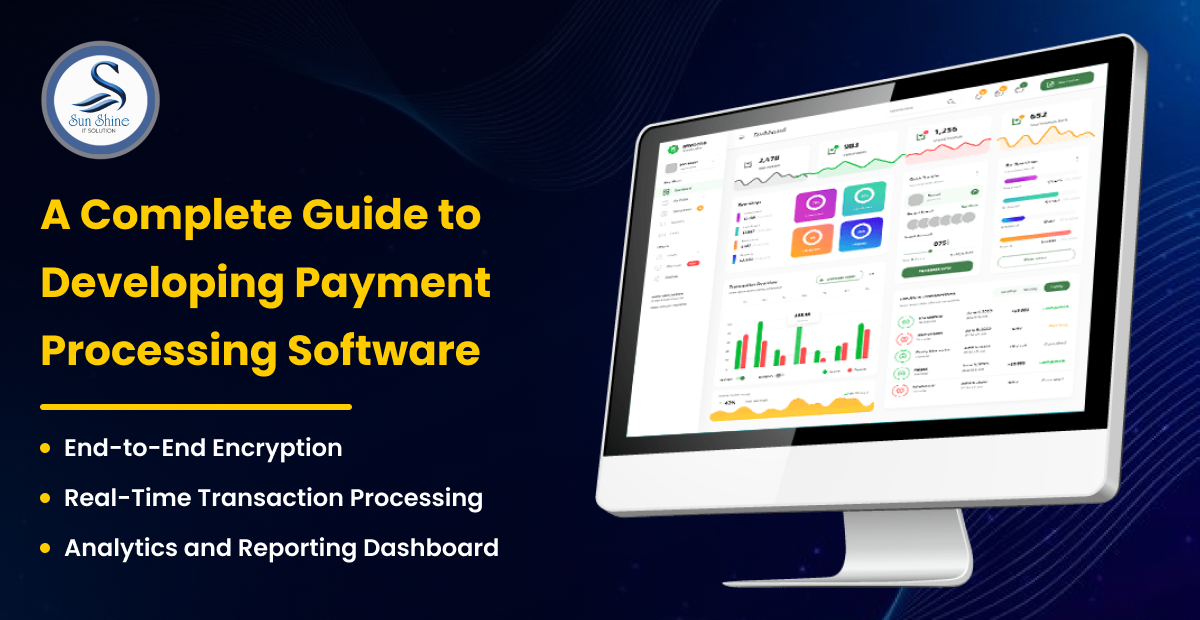
Developing Payment Processing Software is the process of creating a secure digital system that enables businesses to accept, process, and manage financial transactions through various payment methods like cards, UPI, and digital wallets.
Introduction
In today’s digital economy, payment processing software is the backbone of online and offline transactions. Whether it’s e-commerce, mobile apps, or subscription platforms, businesses rely heavily on secure, fast, and reliable payment systems.
At Sun Shine IT Solution, we specialize in building scalable and secure payment solutions tailored to modern business needs. This guide walks you through everything you need to know about developing payment processing software—from fundamentals to advanced implementation.
What is Payment Processing Software?
Payment processing software enables businesses to accept, process, and manage transactions through various payment methods such as:
- Credit/Debit Cards
- Net Banking
- Digital Wallets
- UPI & Real-Time Payments
- Cryptocurrency (optional)
It acts as a bridge between customers, merchants, banks, and payment gateways.
Key Components of Payment Processing Systems
1. Payment Gateway
-
Acts as an intermediary between the customer and the merchant.
- Encrypts sensitive data and ensures secure transmission.
2. Payment Processor
-
Handles the transaction by communicating with issuing and acquiring banks.
3. Merchant Account
-
A specialized account where funds are temporarily held before settlement.
4. Issuing Bank
-
The customer’s bank that approves or declines the transaction.
5. Acquiring Bank
-
The merchant’s bank that receives the payment.
Types of Payment Processing Systems
1. Hosted Payment Gateway
-
Redirects users to a third-party page.
- Easy to implement but less customizable.
2. Integrated Payment Gateway
-
Embedded directly into your website/app.
- Offers better user experience.
3. API-Based Payment System
-
Fully customizable solution using APIs.
- Ideal for businesses needing flexibility.
Essential Features of Payment Processing Software
1. End-to-End Encryption
End-to-end encryption is one of the most critical features in any payment processing system. It ensures that sensitive information such as card details, personal data, and transaction credentials are securely encrypted from the moment a user initiates a transaction until it reaches the payment server. This means that even if data is intercepted during transmission, it cannot be read or misused by unauthorized parties. Strong encryption protocols like SSL (Secure Socket Layer) and TLS (Transport Layer Security) are commonly used to protect data. Implementing this feature not only safeguards user information but also builds trust and credibility for your platform.
2. Multi-Payment Support
A modern payment system must support multiple payment methods to cater to a wide range of users. Customers today expect flexibility, whether they prefer paying through credit cards, debit cards, net banking, digital wallets, UPI, or even cryptocurrencies. Multi-payment support ensures that users are not restricted to a single method, which improves user experience and increases conversion rates. It also helps businesses expand globally by accommodating region-specific payment methods, making the platform more accessible and inclusive.
3. Real-Time Transaction Processing
Real-time transaction processing allows payments to be completed instantly or within seconds. This feature is essential for providing a seamless and efficient user experience. When a customer makes a payment, the system immediately verifies, processes, and confirms the transaction without delays. Real-time processing reduces waiting time, minimizes transaction failures, and ensures accurate updates of balances and records. It is especially important for e-commerce platforms, ticket booking systems, and subscription services where speed is a key factor.
4. Analytics and Reporting Dashboard
An analytics and reporting dashboard provides businesses with valuable insights into their payment activities. This feature allows administrators to track transaction history, monitor revenue, analyze customer behavior, and identify trends. Detailed reports can include metrics such as total sales, successful vs failed transactions, refund rates, and peak transaction times. With these insights, businesses can make data-driven decisions, optimize their operations, and improve overall performance. A well-designed dashboard also helps in financial planning and auditing.
5. Refund and Chargeback Management
Refund and chargeback management is essential for handling disputes and returning payments efficiently. A robust system should allow businesses to process refunds quickly when customers request them due to cancellations, errors, or dissatisfaction. Additionally, chargeback management helps in dealing with disputes raised by customers through their banks. The system should track these cases, provide proper documentation, and help resolve them effectively. Efficient handling of refunds and chargebacks improves customer satisfaction and reduces financial losses.
6. Multi-Currency Support
Multi-currency support enables businesses to accept payments in different currencies from customers around the world. This feature is crucial for companies operating internationally or targeting global markets. It automatically converts currencies based on current exchange rates and displays prices in the user’s local currency. This not only enhances user convenience but also increases trust, as customers can clearly understand how much they are paying. It also simplifies financial operations for businesses dealing with cross-border transactions.
7. Mobile Responsiveness
With the growing use of smartphones, mobile responsiveness is no longer optional—it is essential. Payment processing software must be fully optimized for mobile devices, including smartphones and tablets. This ensures that users can complete transactions بسهولة and securely regardless of screen size or device type. A responsive design improves usability, reduces friction during checkout, and enhances the overall user experience. Mobile-friendly payment systems are especially important for e-commerce and on-the-go services.
8. Tokenization and Fraud Detection
Tokenization is a security technique that replaces sensitive payment information, such as card numbers, with unique tokens. These tokens have no exploitable value if intercepted, making transactions more secure. Alongside tokenization, advanced fraud detection systems use technologies like artificial intelligence and machine learning to identify suspicious activities in real time. These systems analyze patterns, detect anomalies, and flag potentially fraudulent transactions before they are completed. Together, tokenization and fraud detection significantly reduce the risk of data breaches and financial fraud.
Security & Compliance Requirements
Security is critical in payment processing.
Must-follow standards:
-
PCI DSS (Payment Card Industry Data Security Standard)
- SSL/TLS Encryption
- Two-Factor Authentication (2FA)
- GDPR Compliance (if operating globally)
Security Best Practices:
-
Data tokenization
- Regular security audits
- AI-based fraud detection systems
Technology Stack
Frontend:
-
React.js / Angular / Vue.js
Backend:
- Node.js / Java / Python / .NET
Database:
- PostgreSQL / MySQL / MongoDB
APIs:
- RESTful APIs or GraphQL
Cloud & Hosting:
-
AWS / Azure / Google Cloud
Step-by-Step Development Process
Step 1: Requirement Analysis
-
Identify business needs
- Define supported payment methods
Step 2: Choose Payment Integration
-
Decide between third-party or custom solution
Step 3: UI/UX Design
-
Create a seamless and secure checkout experience
Step 4: Backend Development
-
Build transaction logic, APIs, and database
Step 5: Security Implementation
-
Apply encryption, authentication, and compliance measures
Step 6: Testing
-
Functional testing
- Security testing
- Load testing
Step 7: Deployment
-
Launch on cloud infrastructure
- Monitor system performance
Challenges in Payment Software Development
-
Regulatory compliance across regions
- Fraud prevention and risk management
- Handling high transaction volumes
- Integration with multiple banks and APIs
- Ensuring uptime and reliability
Cost of Development
The cost depends on:
- Features and complexity
- Security requirements
- Integration level
- Development time
Estimated Cost:
-
Basic System: $10,000 – $25,000
- Mid-Level Platform: $25,000 – $70,000
- Advanced Enterprise Solution: $70,000+
Future Trends
-
AI-powered fraud detection
- Biometric authentication
- Blockchain-based payments
- Contactless and wearable payments
- Real-time global transactions
Why Choose Sun Shine IT Solution?
At Sun Shine IT Solution, we offer:
- Custom-built payment solutions
- High-level security implementation
- Scalable architecture
- Ongoing support & maintenance
- Affordable pricing for startups and enterprises
We ensure your payment system is fast, secure, and future-ready.
Conclusion
Developing payment processing software is a complex but rewarding endeavor. With the right strategy, technology, and security practices, businesses can create seamless transaction experiences that build trust and drive growth.
If you’re planning to build a payment solution, Sun Shine IT Solution is here to help you every step of the way.