

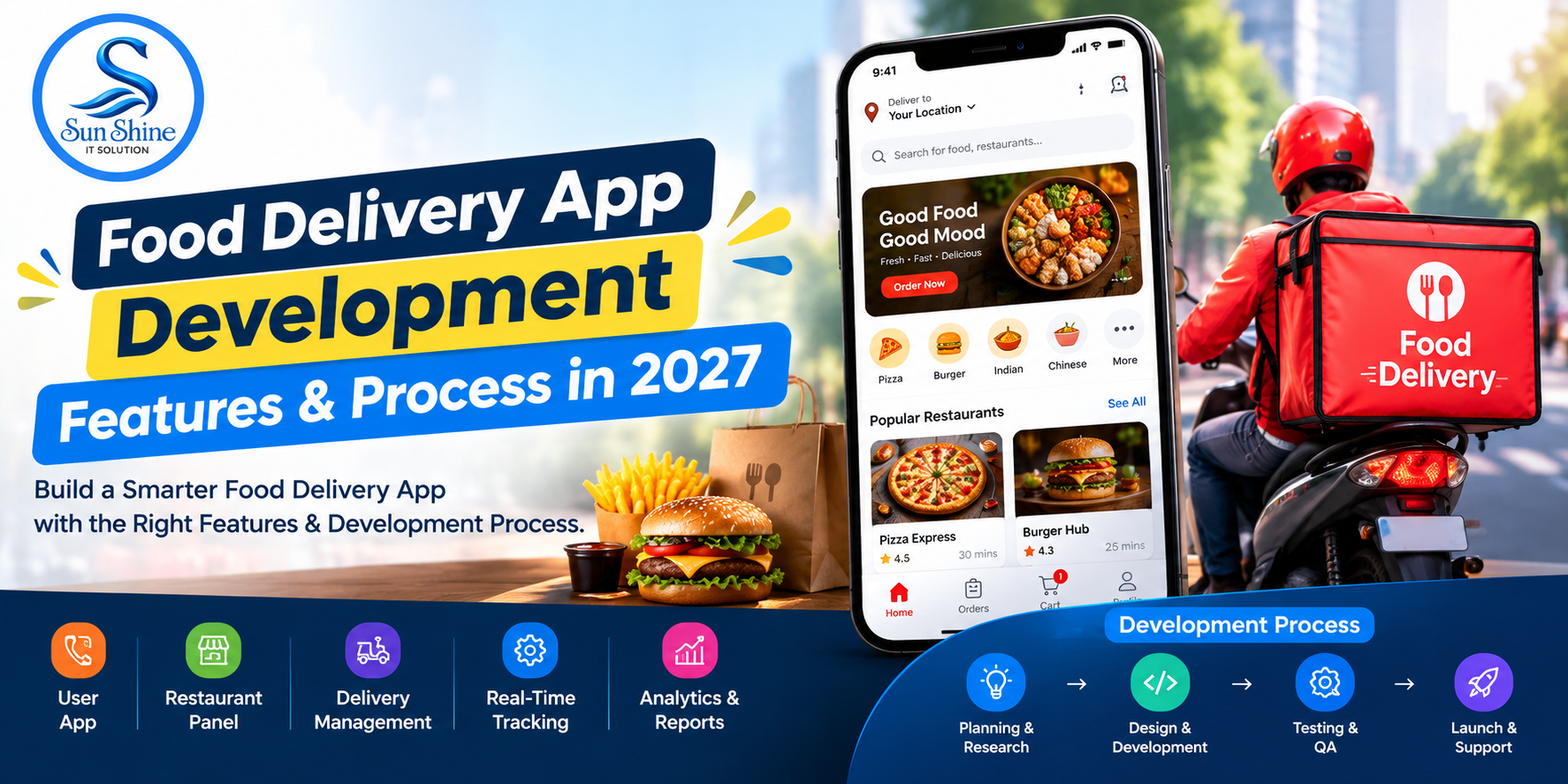
Discover the food delivery app development cost in 2027, essential features, benefits, and development process. Learn how Sun Shine IT Solution can help you build a scalable, user-friendly food delivery application tailored to your business needs.
Introduction
The food delivery industry is changing rapidly as more customers prefer ordering food online through mobile apps. From discovering nearby restaurants to making secure payments and tracking orders in real time, food delivery applications have made ordering food faster and more convenient.
For restaurants, cloud kitchens, food startups, and entrepreneurs, launching a food delivery app can create new business opportunities. However, before starting development, it is important to understand the food delivery app development cost, essential features, development process, and potential business benefits in 2027.
At Sun Shine IT Solution, we develop custom software and mobile applications designed around specific business requirements. Whether you want to build an app for your restaurant or launch a multi-restaurant food delivery platform, the right development strategy can help you establish a strong digital presence and grow your business.
What Is a Food Delivery App?
A food delivery app is a digital platform that connects customers with restaurants, cloud kitchens, and delivery partners. Customers can browse menus, place orders, make payments, and track deliveries directly from their smartphones.
A complete food delivery platform generally includes four major components.
Customer App
Allows users to explore restaurants, order food, make payments, and track deliveries.
Restaurant Panel
Helps restaurant owners manage menus, incoming orders, pricing, and order preparation.
Delivery Partner App
Enables delivery partners to accept orders, navigate routes, and update delivery status.
Admin Dashboard
Allows business owners to manage customers, restaurants, delivery partners, commissions, payments, and reports.
The complexity of these components directly influences the overall food delivery app development cost.
Food Delivery App Development Cost in 2027
The cost of developing a food delivery application depends on its functionality, design, technology, integrations, and business model. A simple restaurant ordering app requires fewer resources than a multi-vendor platform with separate customer, restaurant, and delivery partner applications.
Estimated Development Cost
Basic Restaurant Ordering App
Estimated Cost in India: ₹3 lakh to ₹6 lakh
Approximate Timeline: 2 to 3 months
Feature-Rich Restaurant App
Estimated Cost in India: ₹6 lakh to ₹12 lakh
Approximate Timeline: 3 to 5 months
Multi-Restaurant Delivery Platform
Estimated Cost in India: ₹12 lakh to ₹25 lakh
Approximate Timeline: 4 to 7 months
Advanced Enterprise Platform
Estimated Cost in India: ₹25 lakh to ₹50 lakh or more
Approximate Timeline: 6 to 10 months or more
These are indicative planning estimates, not fixed quotations from Sun Shine IT Solution. Actual pricing and timelines depend on the project scope, development approach, integrations, and delivery requirements.
Basic Food Delivery App
A basic application is suitable for individual restaurants, small food businesses, and startups that want to accept online orders.
Common features include:
- Customer registration and login
- Digital food menu
- Shopping cart and checkout
- Basic order management
- Online payment integration
- Order status notifications
- Basic admin dashboard
This approach allows businesses to establish an online ordering channel without investing in an extensive marketplace.
Medium-Complexity Food Delivery App
A feature-rich application is suitable for growing restaurants, cloud kitchens, and businesses managing multiple outlets.
Common features include:
- Advanced search and food filters
- Restaurant management panel
- Delivery partner management
- Live order tracking
- Coupons and promotional offers
- Ratings and customer reviews
- Multiple payment options
- Sales reports and analytics
These features improve the ordering experience while helping businesses manage daily operations more efficiently.
Advanced Food Delivery Platform
An advanced platform is designed for businesses that want to connect multiple restaurants and delivery partners through a single application.
Common features include:
Separate customer, restaurant, and delivery partner apps
- Real-time GPS tracking
- Automated delivery partner assignment
- Restaurant commission management
- Loyalty programs and subscriptions
- AI-based recommendations
- Advanced analytics
- Multi-city operations and scalability
Advanced platforms require more development time, testing, infrastructure, and ongoing maintenance.
Factors That Affect Food Delivery App Development Cost
Several factors influence the total investment required to build a food delivery application.
1. App Complexity
The number of features and workflows directly affects development effort. A basic ordering app costs less than a platform supporting multiple restaurants, delivery fleets, and automated order assignments.
2. UI/UX Design
An attractive, easy-to-use interface helps customers browse menus and complete orders. Custom animations, interactive maps, personalized screens, and advanced user journeys can increase design costs.
3. Android and iOS Development
Developing for Android, iOS, or both affects the overall budget. Cross-platform technologies may help reduce duplicated development work, depending on the application's requirements.
4. Third-Party Integrations
Payment gateways, maps, location services, SMS, push notifications, and restaurant POS systems may require additional integration and usage fees.
5. Backend and Admin Dashboard
The backend processes orders, payments, notifications, user accounts, and delivery updates. A scalable backend and comprehensive admin dashboard require careful planning and development.
6. Security and Testing
Secure authentication, payment verification, data protection, performance testing, and bug fixing are important parts of a reliable application.
7. Maintenance and Updates
After launch, businesses should budget for hosting, monitoring, bug fixes, operating system updates, third-party services, and new features.
Essential Features of a Food Delivery App in 2027
A successful food delivery application should offer convenience to customers and efficient management tools to business owners.
Customer App Features
User Registration and Login
Customers can create accounts, manage their profiles, and securely access their order history.
Restaurant Discovery
Users can discover nearby restaurants based on location, cuisine, availability, and delivery time.
Smart Search and Filters
Search tools help customers find specific dishes, restaurants, cuisines, and budget-friendly meals.
Digital Menu
Restaurants can display food images, descriptions, prices, add-ons, customization options, and availability.
Shopping Cart and Checkout
Customers can review their selections, apply coupons, choose delivery addresses, and confirm orders.
Multiple Payment Options
Depending on the integration, customers can pay using UPI, debit or credit cards, digital wallets, or cash on delivery.
Real-Time Order Tracking
Customers can view order progress, estimated delivery times, and delivery partner locations where supported.
Push Notifications
Automated alerts provide updates about order confirmation, preparation, dispatch, delivery, and promotional offers.
Ratings and Reviews
Customers can share feedback about restaurants, food quality, and delivery experiences.
Order History and Reordering
Users can review previous orders and quickly order their favorite meals again.
Restaurant Panel Features
Menu and pricing management
Incoming order notifications
Accepting or rejecting orders
Food preparation status updates
Item availability and stock management
Offers and discount management
Sales reports and order history
Commission and payout information
These features help restaurants manage orders efficiently and keep their digital menus updated.
Delivery Partner App Features
- Delivery partner registration and profile
- Online and offline availability
- Order assignment and acceptance
- GPS navigation and route guidance
- Pickup and delivery status updates
- Estimated delivery time
- Earnings and delivery history
- Customer contact options
Delivery confirmation and proof of delivery
A well-designed delivery partner app helps coordinate deliveries and improve operational visibility.
Admin Dashboard Features
The admin dashboard is the central control system for a food delivery business.
Important features include:
Customer and restaurant management
Delivery partner management
Order monitoring and cancellation management
Commission and payment management
Coupon and promotional campaign management
Refund and complaint handling
Delivery zone configuration
Sales and revenue analytics
Reports and business performance tracking
Role-based access and permissions
With centralized administration, business owners can monitor operations and make informed decisions.
Advanced Food Delivery App Features for 2027
As competition increases, businesses can consider advanced capabilities to improve personalization, efficiency, and customer retention.
AI-Based Food Recommendations
AI can analyze relevant order history and customer preferences to recommend dishes and restaurants that may interest users.
Intelligent Delivery Assignment
Automated assignment can consider delivery partner availability, distance, restaurant preparation time, and delivery zones to help allocate orders efficiently.
Personalized Offers
Businesses can use customer preferences and order patterns to create relevant promotional campaigns and encourage repeat purchases.
Voice Search
Voice-enabled search can allow customers to find restaurants and dishes using spoken commands, subject to device and language support.
Predictive Analytics
Analytics tools can help identify popular dishes, peak ordering hours, sales patterns, and potential demand changes.
Chatbot Support
An AI chatbot can answer common questions about menus, order status, delivery policies, and refunds, with escalation to human support when necessary.
Loyalty and Subscription Programs
Reward points, membership plans, and subscription-based benefits can encourage repeat orders and strengthen customer relationships.
Advanced features should be selected according to the business model, target audience, available budget, and expected return on investment.
Benefits of Developing a Food Delivery App
1. Reach More Customers
A mobile application allows businesses to serve customers beyond their immediate walk-in audience, depending on delivery coverage.
2. Increase Ordering Convenience
Customers can browse menus, place orders, and make payments without visiting the restaurant or calling to place an order.
3. Improve Order Management
Digital order processing reduces dependence on manual order-taking and can help minimize communication errors.
4. Build Customer Loyalty
Personalized offers, loyalty points, order history, and convenient reordering can encourage customers to return.
5. Access Business Insights
Sales reports and analytics help business owners understand customer preferences, peak hours, popular products, and revenue trends.
6. Strengthen Brand Identity
A branded application gives restaurants and food businesses greater control over their digital presence and customer experience.
7. Support Business Expansion
A scalable platform can support additional restaurants, delivery partners, locations, and services as business requirements grow.
Why Invest in a Food Delivery Business in 2027?
Investing in a food delivery business can be an opportunity for entrepreneurs who understand their target market and build an effective operating model.
Growing Preference for Online Ordering
Digital ordering provides convenience for customers who want to discover food options and order from their phones.
Multiple Business Models
Entrepreneurs can choose from several approaches.
A single-restaurant ordering application
A multi-restaurant marketplace
A cloud kitchen ordering platform
A subscription-based food delivery service
A specialized platform for healthy meals, desserts, or regional cuisine
Opportunities for Repeat Revenue
Food is a frequently purchased product category. Businesses that deliver consistent quality and service can encourage repeat purchases.
Data-Driven Business Decisions
Digital platforms generate useful operational data that can help businesses improve menus, promotions, delivery coverage, and customer retention.
Scope for Automation
Automated notifications, order management, delivery assignments, and reporting can help reduce repetitive manual work.
However, profitability is not guaranteed. Competition, food quality, restaurant partnerships, delivery costs, customer acquisition, and local demand all influence business performance.
Food Delivery App Development Process
At Sun Shine IT Solution, a structured development approach can help turn your food delivery app idea into a practical digital solution.
Step 1: Business Analysis and Planning
The first step is understanding your business model, target customers, competitors, delivery area, and project goals.
The development team defines the essential features, user roles, workflows, and technical requirements.
Step 2: UI/UX Design
Designers prepare wireframes, user journeys, and interface designs for the customer app, restaurant panel, delivery partner app, and admin dashboard, as required.
The goal is to create an intuitive experience across different devices.
Step 3: Technology Selection
The appropriate technology stack is selected based on scalability, performance, security, budget, and platform requirements.
Possible technologies include Flutter or React Native for cross-platform apps, native mobile technologies where needed, and backend frameworks with suitable databases and cloud infrastructure.
Step 4: Application Development
Developers build the frontend, backend, database, APIs, and required business modules.
The team integrates ordering, payment processing, notifications, restaurant management, delivery workflows, and administrative controls.
Step 5: Third-Party Integration
Required external services, such as payment gateways, maps, location services, SMS, and push notifications, are integrated and configured.
Step 6: Testing and Quality Assurance
The application is tested for functionality, security, performance, usability, and compatibility.
Test scenarios include order placement, payment failures, cancellations, refunds, delivery assignments, and peak-load conditions.
Step 7: Deployment and Launch
After testing and approval, the application is prepared for deployment to the relevant app stores or web hosting environment.
The launch process also includes production configuration, monitoring, and operational readiness.
Step 8: Maintenance and Continuous Improvement
After launch, the application can be improved using customer feedback, usage analytics, and changing business requirements.
Regular maintenance helps keep the platform secure, reliable, and compatible with supported devices and services.
Technology Stack for Food Delivery App Development
The technology stack depends on the project's scope and performance requirements.
- Mobile App Development: Flutter, React Native, native Android and iOS
- Web Development: React, Next.js
- Backend Development: Node.js, Laravel, Django
- Database: PostgreSQL, MySQL, MongoDB
- Maps and Navigation: Google Maps Platform, Mapbox
- Payments: UPI-enabled payment gateways, cards, digital wallets
- Cloud Infrastructure: AWS, Microsoft Azure, Google Cloud
- Notifications: Firebase Cloud Messaging and supported messaging services
These are examples of available technologies, not a mandatory combination. The final stack should be chosen according to the application's needs.
How Can a Food Delivery App Generate Revenue?
A food delivery platform can use one or more revenue models.
Restaurant Commission
The platform earns a percentage of eligible orders from participating restaurants, according to agreed commercial terms.
Delivery Fees
Customers may pay delivery charges based on distance, location, demand, or the business's pricing policy.
Subscription Plans
Customers can purchase membership plans that offer benefits such as eligible delivery discounts or exclusive offers.
Featured Restaurant Listings
Restaurants can pay for promotional placements or sponsored visibility within the platform.
Platform or Service Fees
The business may charge a transparent service fee per order, where appropriate and permitted.
Promotional Partnerships
Food brands and restaurants can pay for campaigns, special placements, or targeted promotions.
The most suitable revenue model depends on operating expenses, market conditions, customer expectations, and restaurant partnerships.
Common Challenges in Food Delivery App Development
Developing an application is only one part of building a successful food delivery business.
Managing Peak Demand
The platform should be designed to handle sudden increases in traffic and orders.
Coordinating Restaurants and Delivery Partners
Clear workflows are needed for order acceptance, preparation, pickup, and delivery.
Maintaining Accurate Delivery Estimates
Preparation delays, traffic, weather, and delivery partner availability can affect estimated arrival times.
Protecting Customer Data
Appropriate security controls are essential for account information, addresses, and payment-related transactions.
Retaining Customers
Consistent service, reliable delivery, quality food, and thoughtful offers can help encourage repeat orders.
Controlling Operating Costs
Hosting, third-party APIs, customer support, promotions, and delivery operations must be considered alongside development costs.
Planning for these challenges early can reduce operational problems after launch.
How to Choose the Right Food Delivery App Development Company
Choosing the right development partner is an important step toward building a reliable application.
Before selecting a company, consider the following:
- Experience in mobile app and custom software development
- Ability to understand your business requirements
- Transparent project scope, pricing, and timelines
- UI/UX design and quality assurance practices
- Secure payment and third-party integrations
- Scalability and future feature development
- Post-launch maintenance and technical support
At Sun Shine IT Solution, our focus is on developing software solutions tailored to business workflows and project objectives. A clear discussion of your requirements helps establish the appropriate development scope and budget.
Why Choose Sun Shine IT Solution for Food Delivery App Development?
Every food business has different requirements. A local restaurant may need a simple branded ordering application, while a startup may require a complete multi-restaurant delivery marketplace.
Sun Shine IT Solution provides custom software development services to help businesses build digital solutions around their specific needs.
We can help plan and develop a food delivery solution with features such as:
- Custom UI/UX design
- Customer ordering and account management
- Restaurant and menu management
- Delivery partner workflows
- Online payment integration
- Order tracking and notifications
- Admin dashboard and reporting
- Scalable backend architecture
- Ongoing improvements based on business needs
Our approach focuses on matching the application to your business model rather than adding unnecessary features.
Whether you are starting a new food delivery business or digitizing an existing restaurant, the first step is to define your goals, essential features, and launch budget.
Final Words
Food delivery app development in 2027 offers opportunities for restaurants, cloud kitchens, startups, and entrepreneurs looking to expand their digital operations. However, the right solution depends on more than development cost alone.
A successful application combines a convenient customer experience, reliable restaurant workflows, efficient delivery management, secure payments, and useful business analytics.
Starting with essential features and expanding gradually can help businesses manage initial investment while learning from real customer feedback.
Sun Shine IT Solution can help you plan a custom food delivery application that aligns with your business goals, budget, and future growth plans.
Ready to turn your food delivery app idea into a digital product? Contact Sun Shine IT Solution to discuss your requirements and explore a suitable development approach.